Our curriculum
Ambitious learning.
Adapted routes.
Meaningful progress.
An academic core of English Language, mathematics and science, delivered by Expert Teachers around each learner’s starting point and next steps.
A curriculum built around the learner.
Learners may have experienced disrupted education, reduced attendance, unmet SEND needs or a loss of confidence. We begin with prior knowledge, current engagement, needs, EHCP outcomes where applicable and intended next steps.
Learners do not have to enter at a fixed age-related point. Previous school information and professional judgement help teachers choose an appropriate starting point, address important gaps and build towards an ambitious pathway.
The learner does not adapt to the provision;
the provision adapts to the learner.
Three subjects. Secure foundations.
English Language
Reading, writing and spoken language. A sequenced pathway informed by Oak National Academy towards AQA GCSE English Language.
Explore English Language →Mathematics
Fluency, reasoning and problem-solving. A coherent progression informed by White Rose Maths, with Foundation and Higher Tier pathways where appropriate.
Explore Mathematics →Science
Biology, Chemistry and Physics. Secure scientific knowledge, practical investigation and pathways towards Combined or Separate Sciences where appropriate.
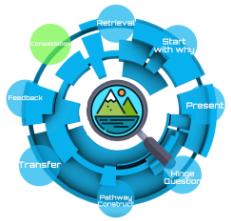
Explore Science →How we teach: seven connected pillars.
- 01
Retrieval Practice
Activate relevant prior knowledge through supportive, low-stakes retrieval. Identify misconceptions and strengthen long-term retention.
- 02
Starting with Why
Give learning a purpose through a question, real-world example, demonstration or story.
- 03
Explicit Instruction
Break new knowledge into manageable steps using clear explanation, modelling, worked examples and carefully chosen vocabulary.
- 04
Engaging Visual Stimuli
Use purposeful images, demonstrations, videos and models to make complex ideas more concrete.
- 05
Hinge Questioning
Check understanding at important points and decide whether to progress, revisit or provide further support.
- 06
Supportive Guided Practice
Practise alongside an Expert Teacher. Gradually withdraw scaffolding as competence and independence develop.
- 07
Exam Transfer and Application
Where appropriate, apply knowledge to GCSE-style questions, unfamiliar problems, extended responses and authentic subject contexts.
Equal access does not require identical provision.
EHCPs, professional reports, school information, learner voice and ongoing assessment inform individual adaptations. These change how learners access the curriculum, without automatically reducing what they are expected to know.
- Typing or scribing where appropriate
- Additional processing time
- Task chunking
- Visual prompts and models
- Explicit vocabulary instruction
- Practical or verbal responses
- Low-stakes assessment
- Adapted resources
- Changes to pace
- Reduced writing without reduced challenge
Assessment that supports progress.
We do not rely on heavy initial diagnostic testing. Expert Teachers build a picture of what a learner knows and can independently apply through previous information, observation, retrieval, questioning and responses to tasks.
Understand the starting point
Bring together previous information, skilled observation and supportive checks of understanding.
Build authentic success
Develop confidence and competence through explicit instruction, guided practice and increasing independence.
Assess when it is useful
Introduce more formal assessment when the learner is ready and the information will meaningfully guide next steps.
Progress includes knowledge, engagement, academic routines, independence and the ability to apply learning. Assessment informs teaching, scaffolding, reviews and reintegration planning.
GCSE pathways and the next destination.
Where GCSE study is part of a commissioned programme, we protect credible pathways towards appropriate qualifications. Foundation or Higher Tier mathematics and Combined Science are considered through prior attainment, demonstrated competence, aspirations and ongoing assessment. Separate Sciences can be maintained where appropriate.
GCSE entry is not the only measure of success. Shorter-term provision may focus on re-engagement, closing gaps and preparing for reintegration, further education, training or a longer-term Alternative Provision pathway.
Alternative Provision
An ambitious core within a programme agreed around the learner.
Explore Alternative Provision →Tuition & home learning
The same teaching principles, with scope and timetable matched to the chosen route.
Explore Tuition & home learning →Explore the detail with us.
Our full Curriculum Overview explains curriculum intent, sequencing, adaptive teaching, assessment and five-year subject pathways.
Ask about the curriculum
